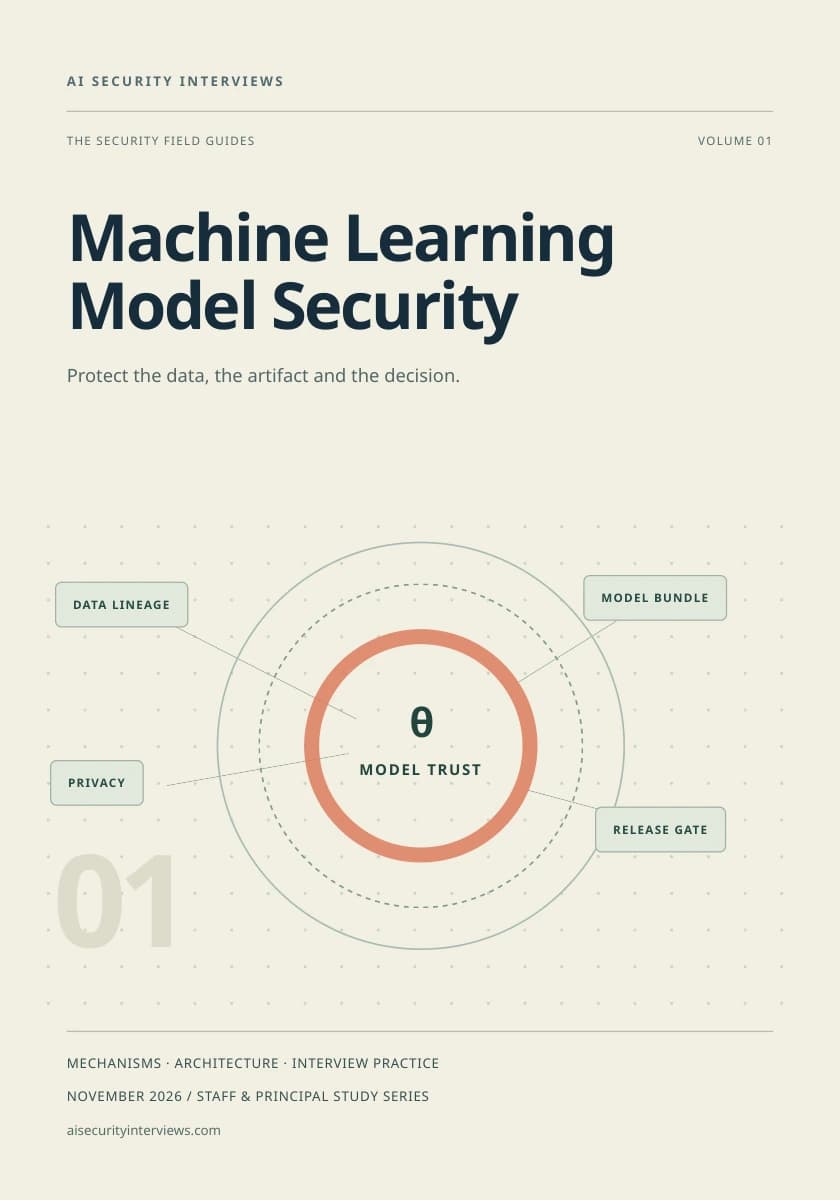
Trace model risk from dataset intake to inference. Learn poisoning defenses, privacy accounting, artifact admission and evidence-based release decisions.
Admit an external model only when its complete bundle, signer and execution paths satisfy an explicit policy.
Separate empirical robustness, privacy guarantees and infrastructure isolation when reviewing a release.
Investigate suspicious training data without destroying the lineage needed to scope affected models.
Defend a model deployment with concrete release criteria, operational limits and a tested rollback path.
Inside the book
01. Start with the system that makes a decisionp. 4
02. Build an inventory that survives a rollbackp. 6
03. Treat dataset intake as a write boundaryp. 8
04. Investigate poisoning without trusting a detectorp. 10
05. Admit model bundles through a narrow gatep. 12
06. Separate parsing safety from model safetyp. 14
07. Keep training authority separate from release authorityp. 16
08. Evaluate robustness against a stated threatp. 18
09. Use certificates only within their assumptionsp. 20
10. Distinguish privacy leakage from model theftp. 22
11. Make differential privacy an auditable claimp. 24
12. Interpret privacy measurements at the base ratep. 26
13. Review federated learning as a distributed protocolp. 28
14. Protect the serving process and its hidden interfacesp. 30
15. Match hardware isolation to the adversaryp. 32
16. Run a release review with explicit stop conditionsp. 34
17. Contain an incident without erasing its historyp. 36
18. Practise with offline control checksp. 38
19. Work through three staff-level design casesp. 40
Read a few pages
Select a page for a larger view. A text version is available beneath each sample.
Build an inventory that survives a rollback
Page 6 of 43
Read sample text
C H A P T E R 0 2
Build an inventory that survives a
rollback
The security unit is a release bundle. It includes weights, tokenizer, configuration, preprocessing,
postprocessing, dependencies and evaluation evidence. A weight digest alone does not identify the
behavior that ran. Different preprocessing can change the effective input; a changed label map can
reverse the meaning of the same numeric prediction.
Begin the inventory with the production endpoint and work backward. Record which release is active,
which deployment identity selected it and which artifact files it loads. Record whether dependencies
are resolved during startup. A worker that fetches “latest” is creating a new release without the
release process, even if the original container was reviewed.
Bind inputs to an output
SLSA provenance distinguishes the produced artifact from the build information supporting it. Use
that distinction for model releases: an attestation should identify the output digest and enough build
inputs to reproduce or investigate it. [S05] The organization must still decide which builder identities,
source repositories and approval policies are acceptable.
For an ML release, maintain the dataset snapshot, training code revision, dependency image digest,
training configuration, base-model revision and evaluation manifest. The record should identify
sensitive inputs without copying those inputs into a broadly readable metadata store. A protected
dataset identifier can be preferable to a raw storage URL that reveals a customer name.
Machine Learning Model Security
SECURITY FIELD GUIDES
aisecurityinterviews.com / field guides
6
Evaluate robustness against a stated threat
Page 18 of 43
Read sample text
C H A P T E R 0 8
Evaluate robustness against a stated
threat
Robustness is always relative to a threat model. A classifier that tolerates one bounded image
perturbation has not been shown safe against altered metadata, distribution shift or poisoned
training data. The test report should identify the input domain, attacker knowledge, allowed changes,
query budget, success criterion and the exact candidate bundle.
Distinguish a naturally occurring error from a deliberately selected input. Both may harm users, but
the evaluation methods and controls differ. If an attacker can repeatedly observe outcomes and
adapt, a single fixed benchmark may underestimate the risk. If the real attacker cannot change a
field, allowing that field to vary can overstate practical risk.
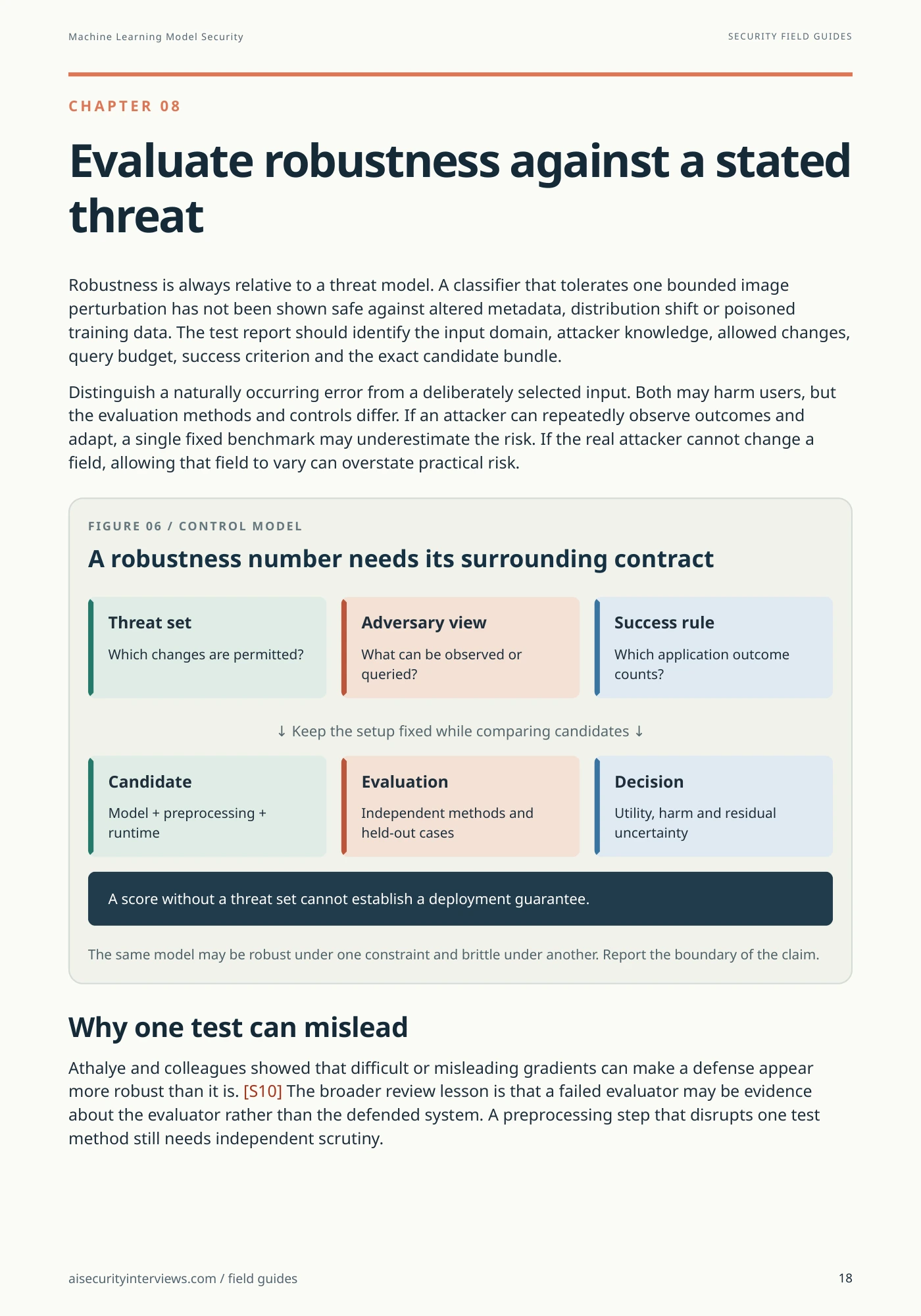
FIGURE 06 / CONTROL MODEL
A robustness number needs its surrounding contract
Threat set
Which changes are permitted?
Adversary view
What can be observed or
queried?
Success rule
Which application outcome
counts?
↓ Keep the setup fixed while comparing candidates ↓
Candidate
Model + preprocessing +
runtime
Evaluation
Independent methods and
held-out cases
Decision
Utility, harm and residual
uncertainty
A score without a threat set cannot establish a deployment guarantee.
The same model may be robust under one constraint and brittle under another. Report the boundary of the claim.
Why one test can mislead
Athalye and colleagues showed that difficult or misleading gradients can make a defense appear
more robust than it is. [S10] The broader review lesson is that a failed evaluator may be evidence
about the evaluator rather than the defended system. A preprocessing step that disrupts one test
method still needs independent scrutiny.
Machine Learning Model Security
SECURITY FIELD GUIDES
aisecurityinterviews.com / field guides
18
Match hardware isolation to the adversary
Page 32 of 43
Read sample text
C H A P T E R 1 5
Match hardware isolation to the
adversary
Hardware controls answer specific questions about co-tenants, host operators, memory and device
access. They do not produce one universal “secure GPU” state. Start by naming the party from whom
weights or inputs must be protected, then inspect the actual deployment boundary.
A dedicated GPU can reduce sharing but still runs under a host administrator. A partitioning feature
may provide defined resource or fault isolation without protecting plaintext from privileged host
software. Confidential computing can change that trust boundary when the supported hardware,
firmware, software and attestation policy are correctly deployed. [S13]
Attestation must influence a decision
An attestation report is evidence to a verifier. A useful design checks expected measurements,
security configuration, freshness and relevant platform status before releasing a decryption key or
admitting a workload. Merely logging “attestation succeeded” without identifying the policy or key-
release consequence is weak assurance.
Keep the verifier and key-release policy outside the workload being evaluated. Otherwise a
compromised workload can approve its own environment. Define how policy changes, revocations
and verifier outages affect running and newly starting jobs. Availability choices should be explicit:
refusing a new key release may be safer than silently bypassing verification.
Machine Learning Model Security
SECURITY FIELD GUIDES
aisecurityinterviews.com / field guides
32
A 43-page PDF with selectable text, linked contents, 12 diagrams, worked cases and references. The web previews are actual pages from this edition.
Which membership includes this book?
An active paid Premium membership, eligible All-Access Pass or approved full-access grant includes the PDF. Referral study days unlock online learning but exclude downloads. You can keep a file you downloaded while eligible.
How does this fit with the online material?
Use the book for a connected reading sequence. Chapter links lead to concepts, worked questions and courses on this site, where the access tier of each page still applies.
Does it include live attack labs?
The exercises teach defensive reasoning and offline checks with synthetic data. There are no working exploits or injection payloads. Testing guidance is limited to systems you own or are explicitly authorized to assess.
Technical sources reviewed 2026-11-11. Product details can change; the book distinguishes research findings from guarantees for a deployed system.