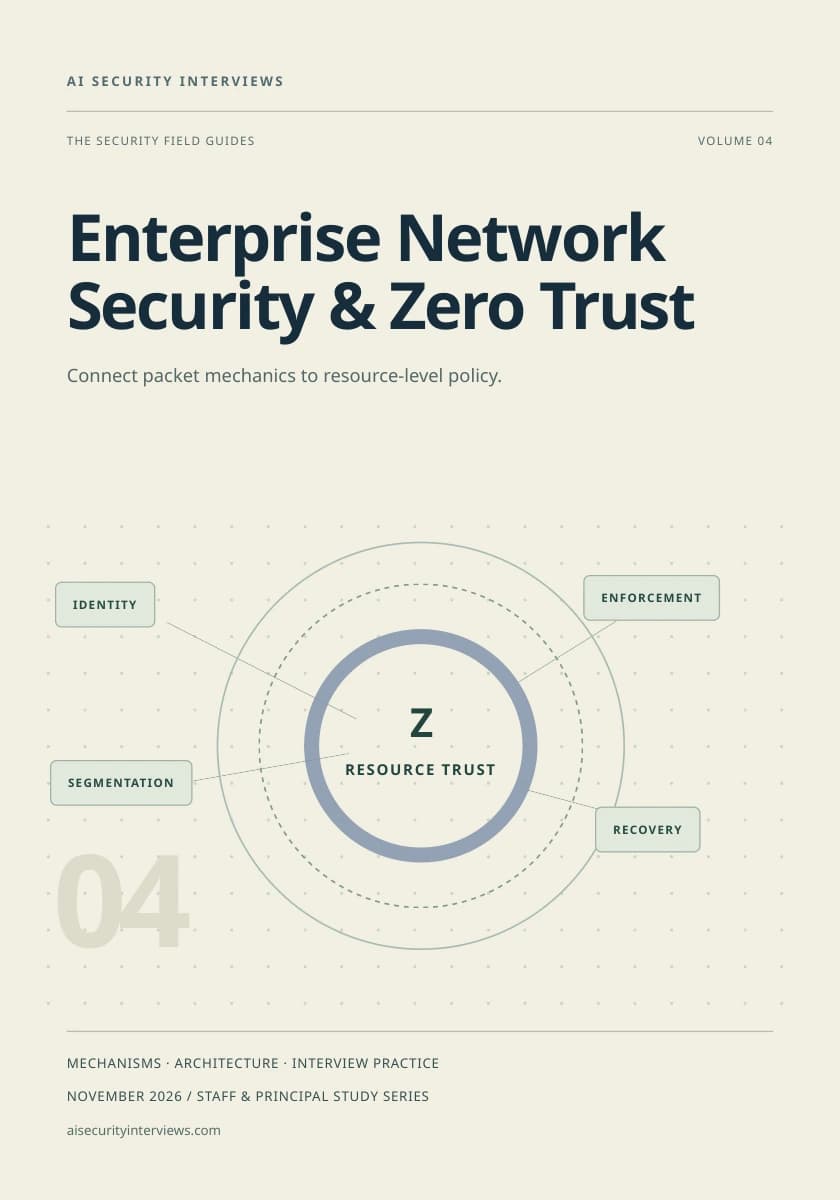
Explain where packet filtering, transport authentication and application authorization each apply.
Build a zero-trust access path with explicit identity, posture, policy, revocation and failure behavior.
Segment cloud, Kubernetes and AI-cluster networks while preserving necessary operational dependencies.
Plan migrations and incident recovery with measurable evidence, tested rollback and bounded exceptions.
Inside the book
01. Begin with a resource operation, then draw the networkp. 4
02. Understand packet mechanics before writing filtersp. 6
03. Treat IPv6 as a first-class policy surfacep. 8
04. Match transport controls to the resource being exhaustedp. 10
05. Make routing authorization narrower than reachabilityp. 12
06. Bind campus admission to a managed identityp. 14
07. Place stateful filters on paths they can observep. 16
08. Engineer detection around reconstruction and lossp. 18
09. Authenticate the endpoint across every TLS terminationp. 20
10. Decide where inspection is justified and technically possiblep. 22
11. Turn zero trust into explicit policy decisionsp. 24
12. Migrate remote access by application dependencyp. 26
13. Segment around the consequences of compromisep. 28
14. Separate cloud connectivity from data authorizationp. 30
15. Make Kubernetes network policy match the actual dataplanep. 32
16. Issue workload identities from verifiable execution contextp. 34
17. Isolate the different planes of an AI clusterp. 36
18. Constrain agent egress at the connection and requestp. 38
19. Protect scarce resources before they saturatep. 40
20. Preserve a management and recovery path you can trustp. 42
21. Measure enforcement, not the number of deployed productsp. 44
22. Work three architecture cases from first principlesp. 46
23. Rehearse policy decisions with offline exercisesp. 48
Read a few pages
Select a page for a larger view. A text version is available beneath each sample.
Make routing authorization narrower than reachability
Page 12 of 53
Read sample text
C H A P T E R 0 5
Make routing authorization
narrower than reachability
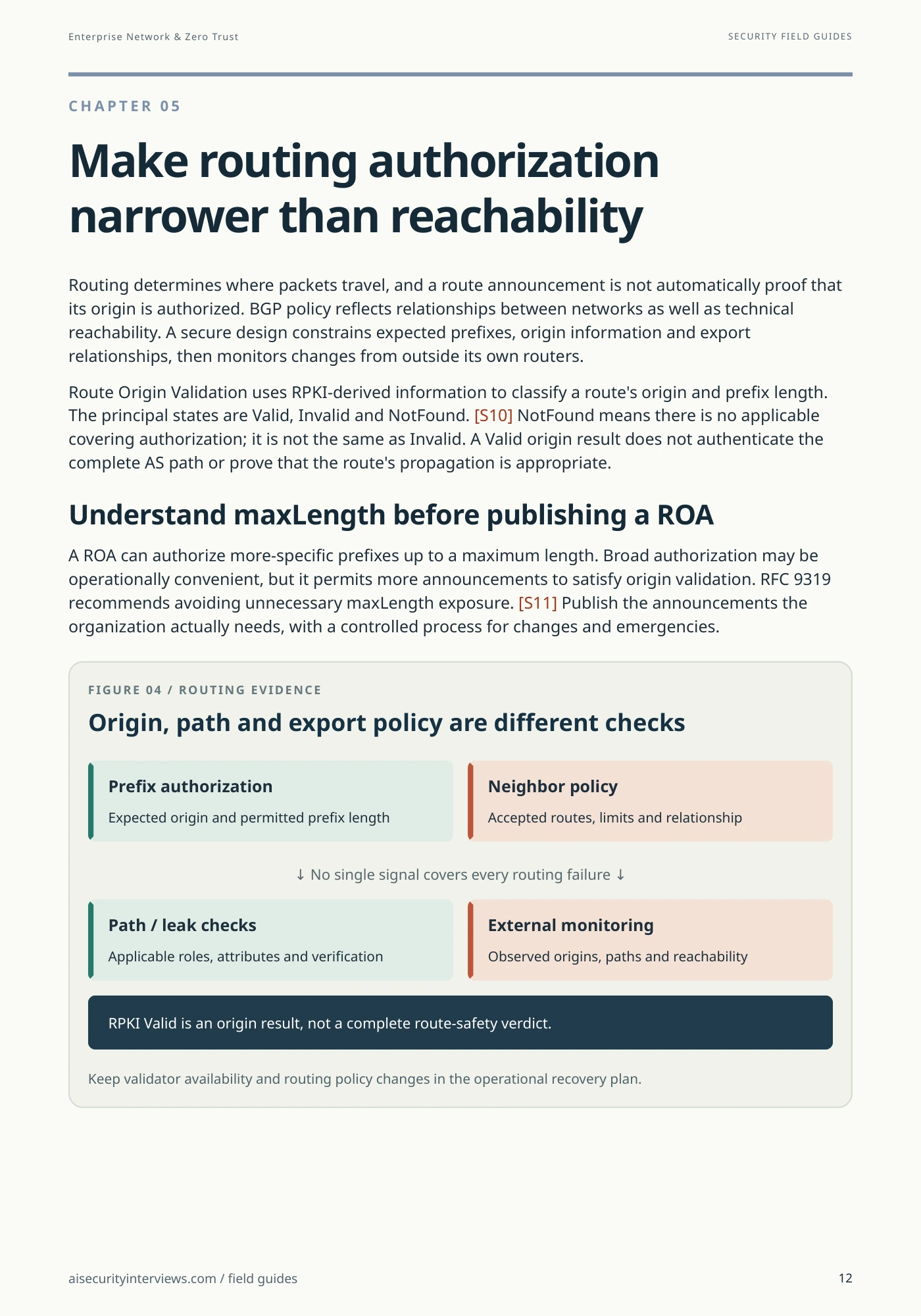
Routing determines where packets travel, and a route announcement is not automatically proof that
its origin is authorized. BGP policy reflects relationships between networks as well as technical
reachability. A secure design constrains expected prefixes, origin information and export
relationships, then monitors changes from outside its own routers.
Route Origin Validation uses RPKI-derived information to classify a route's origin and prefix length.
The principal states are Valid, Invalid and NotFound. [S10] NotFound means there is no applicable
covering authorization; it is not the same as Invalid. A Valid origin result does not authenticate the
complete AS path or prove that the route's propagation is appropriate.
Understand maxLength before publishing a ROA
A ROA can authorize more-specific prefixes up to a maximum length. Broad authorization may be
operationally convenient, but it permits more announcements to satisfy origin validation. RFC 9319
recommends avoiding unnecessary maxLength exposure. [S11] Publish the announcements the
organization actually needs, with a controlled process for changes and emergencies.
FIGURE 04 / ROUTING EVIDENCE
Origin, path and export policy are different checks
Prefix authorization
Expected origin and permitted prefix length
Neighbor policy
Accepted routes, limits and relationship
↓ No single signal covers every routing failure ↓
Path / leak checks
Applicable roles, attributes and verification
External monitoring
Observed origins, paths and reachability
RPKI Valid is an origin result, not a complete route-safety verdict.
Keep validator availability and routing policy changes in the operational recovery plan.
Enterprise Network & Zero Trust
SECURITY FIELD GUIDES
aisecurityinterviews.com / field guides
12
Turn zero trust into explicit policy decisions
Page 24 of 53
Read sample text
C H A P T E R 1 1
Turn zero trust into explicit policy
decisions
Zero trust starts from resource access rather than treating location as sufficient evidence of trust.
NIST distinguishes policy decision and enforcement responsibilities, including the policy engine,
policy administrator and policy enforcement point. [S01] These are logical roles; a product may
combine them, but the architecture still needs to explain their interactions.
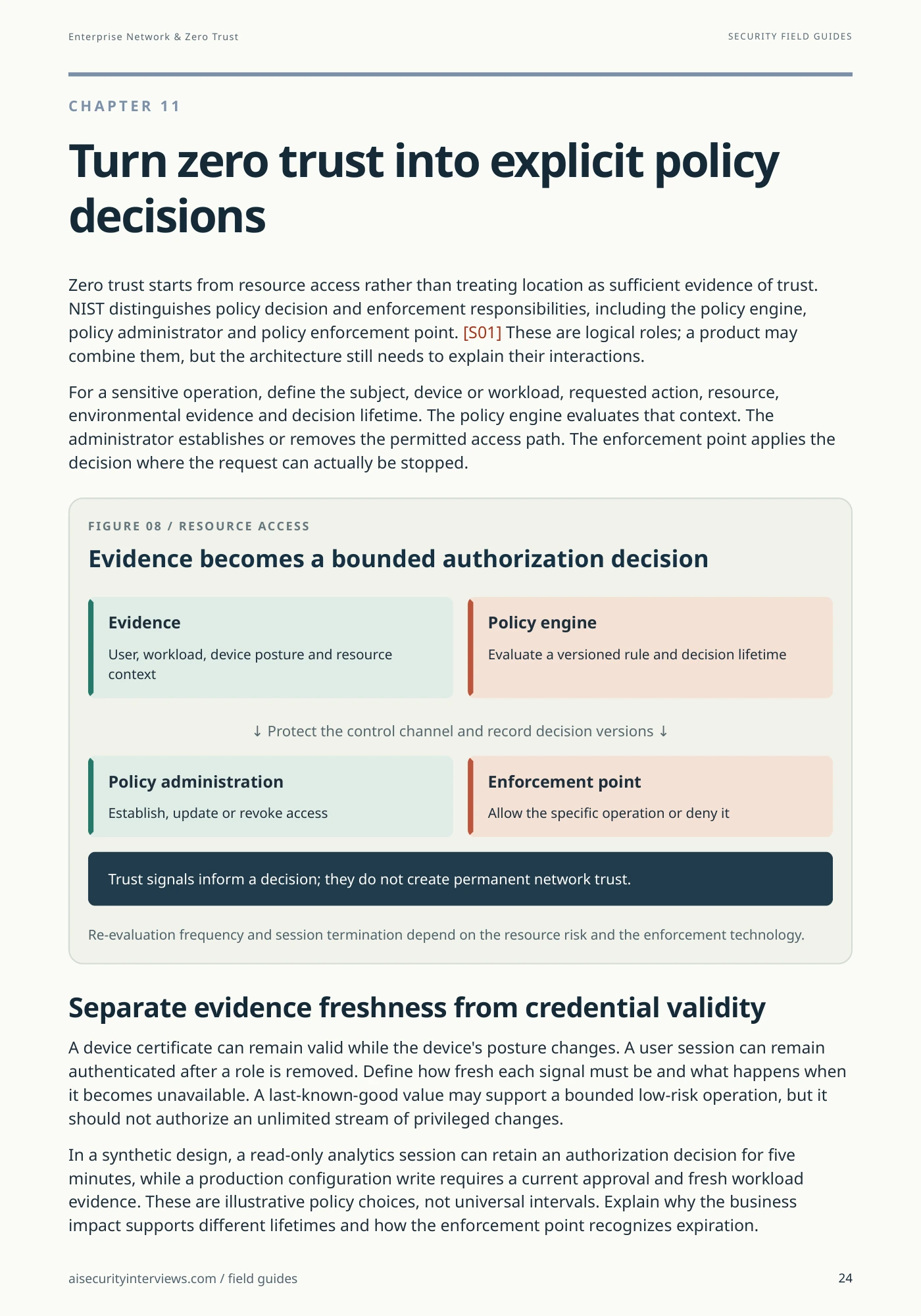
For a sensitive operation, define the subject, device or workload, requested action, resource,
environmental evidence and decision lifetime. The policy engine evaluates that context. The
administrator establishes or removes the permitted access path. The enforcement point applies the
decision where the request can actually be stopped.
FIGURE 08 / RESOURCE ACCESS
Evidence becomes a bounded authorization decision
Evidence
User, workload, device posture and resource
context
Policy engine
Evaluate a versioned rule and decision lifetime
↓ Protect the control channel and record decision versions ↓
Policy administration
Establish, update or revoke access
Enforcement point
Allow the specific operation or deny it
Trust signals inform a decision; they do not create permanent network trust.
Re-evaluation frequency and session termination depend on the resource risk and the enforcement technology.
Separate evidence freshness from credential validity
A device certificate can remain valid while the device's posture changes. A user session can remain
authenticated after a role is removed. Define how fresh each signal must be and what happens when
it becomes unavailable. A last-known-good value may support a bounded low-risk operation, but it
should not authorize an unlimited stream of privileged changes.
In a synthetic design, a read-only analytics session can retain an authorization decision for five
minutes, while a production configuration write requires a current approval and fresh workload
evidence. These are illustrative policy choices, not universal intervals. Explain why the business
impact supports different lifetimes and how the enforcement point recognizes expiration.
Enterprise Network & Zero Trust
SECURITY FIELD GUIDES
aisecurityinterviews.com / field guides
24
Isolate the different planes of an AI cluster
Page 36 of 53
Read sample text
C H A P T E R 1 7
Isolate the different planes of an AI
cluster
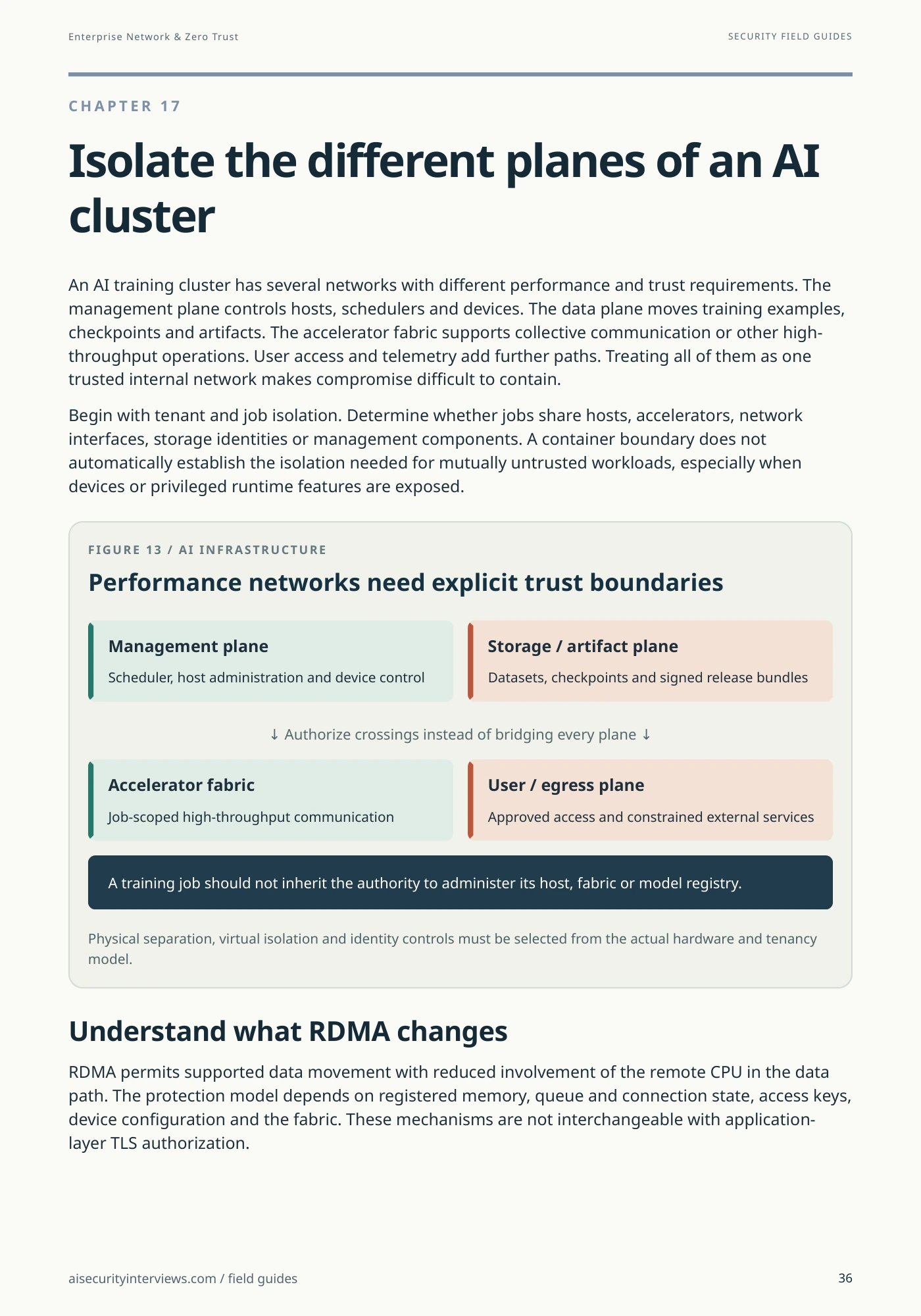
An AI training cluster has several networks with different performance and trust requirements. The
management plane controls hosts, schedulers and devices. The data plane moves training examples,
checkpoints and artifacts. The accelerator fabric supports collective communication or other high-
throughput operations. User access and telemetry add further paths. Treating all of them as one
trusted internal network makes compromise difficult to contain.
Begin with tenant and job isolation. Determine whether jobs share hosts, accelerators, network
interfaces, storage identities or management components. A container boundary does not
automatically establish the isolation needed for mutually untrusted workloads, especially when
devices or privileged runtime features are exposed.
FIGURE 13 / AI INFRASTRUCTURE
Performance networks need explicit trust boundaries
Management plane
Scheduler, host administration and device control
Storage / artifact plane
Datasets, checkpoints and signed release bundles
↓ Authorize crossings instead of bridging every plane ↓
Accelerator fabric
Job-scoped high-throughput communication
User / egress plane
Approved access and constrained external services
A training job should not inherit the authority to administer its host, fabric or model registry.
Physical separation, virtual isolation and identity controls must be selected from the actual hardware and tenancy
model.
Understand what RDMA changes
RDMA permits supported data movement with reduced involvement of the remote CPU in the data
path. The protection model depends on registered memory, queue and connection state, access keys,
device configuration and the fabric. These mechanisms are not interchangeable with application-
layer TLS authorization.
Enterprise Network & Zero Trust
SECURITY FIELD GUIDES
aisecurityinterviews.com / field guides
36
A 53-page PDF with selectable text, linked contents, 17 diagrams, worked cases and references. The web previews are actual pages from this edition.
Which membership includes this book?
An active paid Premium membership, eligible All-Access Pass or approved full-access grant includes the PDF. Referral study days unlock online learning but exclude downloads. You can keep a file you downloaded while eligible.
How does this fit with the online material?
Use the book for a connected reading sequence. Chapter links lead to concepts, worked questions and courses on this site, where the access tier of each page still applies.
Does it include live attack labs?
The exercises teach defensive reasoning and offline checks with synthetic data. There are no working exploits or injection payloads. Testing guidance is limited to systems you own or are explicitly authorized to assess.
Technical sources reviewed 2026-11-11. Product details can change; the book distinguishes research findings from guarantees for a deployed system.