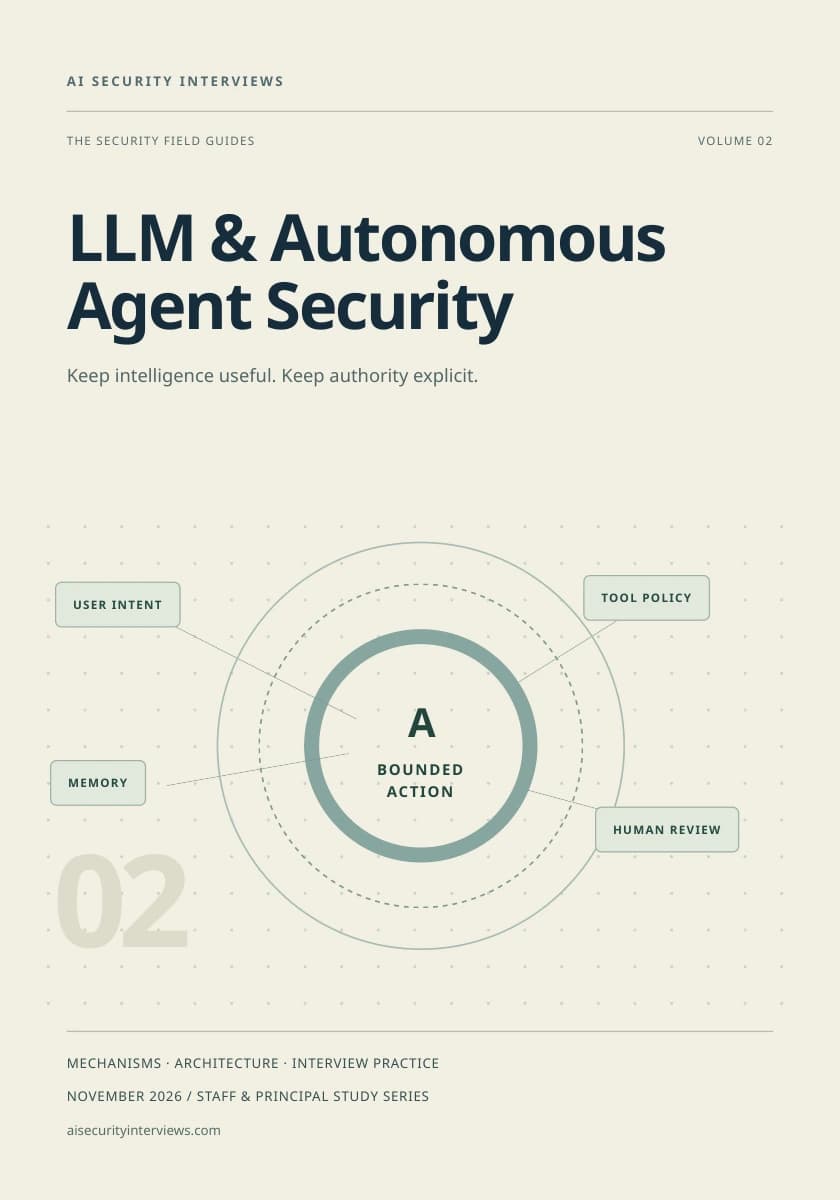
Design agents that can read untrusted material without inheriting its authority. Connect retrieval, delegated identity, tool policy, memory and approvals into a defensible system.
Separate model-generated proposals from the authority required to execute them.
Carry identity, data provenance and resource limits through retrieval, tools and delegated agents.
Bind human approval to exact effects and make retries safe across durable workflows.
Evaluate the complete application with measurable security invariants and usable incident evidence.
Inside the book
01. Start with the effect, then map the agentp. 4
02. Use taxonomies without outsourcing judgmentp. 6
03. Prompt injection is an authority confusionp. 8
04. Separate workflow decisions from untrusted valuesp. 10
05. Delegate identity without enlarging authorityp. 12
06. Design tools around business effectsp. 14
07. Secure MCP as a protocol and a software supply chainp. 16
08. Build an ingestion path that preserves provenancep. 18
09. Authorize retrieval before content reaches contextp. 20
10. Treat embeddings and context as sensitive datap. 22
11. Make memory a governed publication processp. 24
12. Render answers without creating new channelsp. 26
13. Isolate execution and remove ambient credentialsp. 28
14. Give browser agents a narrow view of the worldp. 30
15. Bind approval to the exact actionp. 32
16. Make retries, budgets and cancellation durablep. 34
17. Keep multi-agent delegation narrower than the parent taskp. 36
18. Evaluate the whole workflow, including useful completionp. 38
19. Observe enough to reconstruct an incidentp. 40
20. Work three design cases to a decisionp. 42
21. Offline exercises for grants and evidencep. 44
Read a few pages
Select a page for a larger view. A text version is available beneath each sample.
Separate workflow decisions from untrusted values
Page 10 of 47
Read sample text
C H A P T E R 0 4
Separate workflow decisions from
untrusted values
Some tasks have a stable structure: retrieve a record, compute a summary, show a draft. Others
require the agent to explore and revise its plan. Choose controls that match that difference. If the
task is already known, representing it as an explicit workflow can remove unnecessary model
discretion. If the task is open-ended, bounded capabilities and checkpoints matter more than
pretending the plan will never change.
CaMeL demonstrates a design that separates control flow from untrusted data and applies capability-
based checks to data flows. Its security argument depends on the interpreter, policies and
assumptions in the construction. It is evidence for a valuable architectural pattern, not a universal
guarantee for any application that uses two models or a “planner” prompt. [S03]
A concrete workflow contract
Suppose a user requests an internal summary of invoices from an approved account. The contract
names the account, allowed sources, output audience, expiry and maximum work. A retrieval tool
returns typed invoice records. A summarizer produces a candidate summary. A delivery service
checks that the destination remains internal and authorized. If the model proposes paying an invoice,
that operation falls outside the contract.
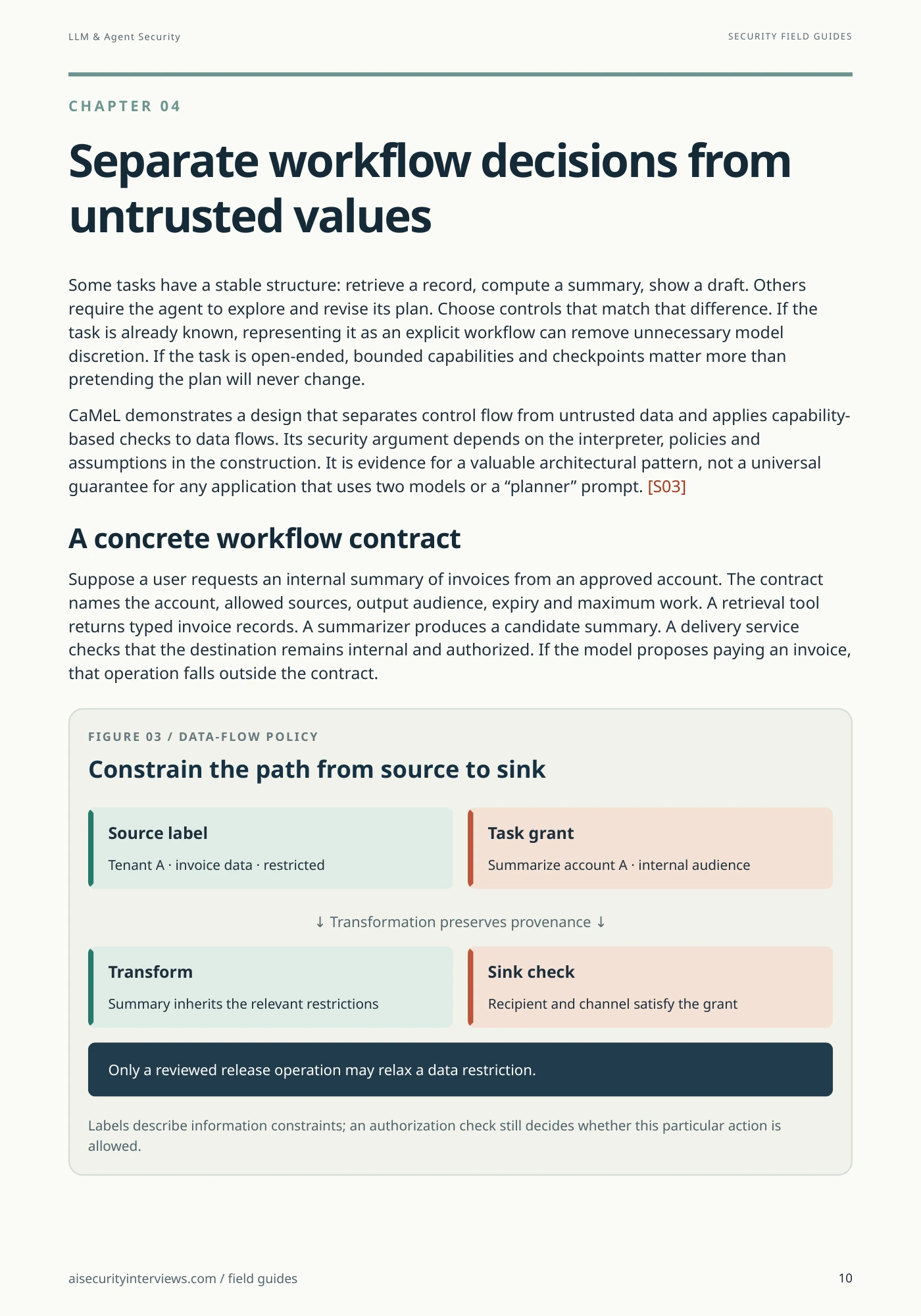
FIGURE 03 / DATA-FLOW POLICY
Constrain the path from source to sink
Source label
Tenant A · invoice data · restricted
Task grant
Summarize account A · internal audience
↓ Transformation preserves provenance ↓
Transform
Summary inherits the relevant restrictions
Sink check
Recipient and channel satisfy the grant
Only a reviewed release operation may relax a data restriction.
Labels describe information constraints; an authorization check still decides whether this particular action is
allowed.
LLM & Agent Security
SECURITY FIELD GUIDES
aisecurityinterviews.com / field guides
10
Secure MCP as a protocol and a software supply chain
Page 16 of 47
Read sample text
C H A P T E R 0 7
Secure MCP as a protocol and a
software supply chain
MCP standardizes how a client discovers and calls capabilities. It does not make every server, tool
description or result trustworthy. A remote server can be properly authenticated and still return
misleading content. A local server is executable software with the privileges of its runtime. Review
both the protocol boundary and the implementation that handles it.
Pin the protocol revision in a design review. The July 28, 2026 revision differs from older session-
oriented deployments. Do not carry assumptions about initialization, sessions or task mechanisms
across revisions without checking the applicable specification and extension set. The authorization
material cited here is revision-specific; interoperability testing must include the versions actually
deployed. [S05] [S16]
Four reviews for every server
First, review provenance: package or image digest, source owner, build evidence and update channel.
Second, review authority: runtime identity, accessible data, filesystem, network and downstream
credentials. Third, review interface: tool names, schemas, descriptions and annotations. Fourth,
review behavior: actual calls, unexpected destinations, persistent state and failure handling.
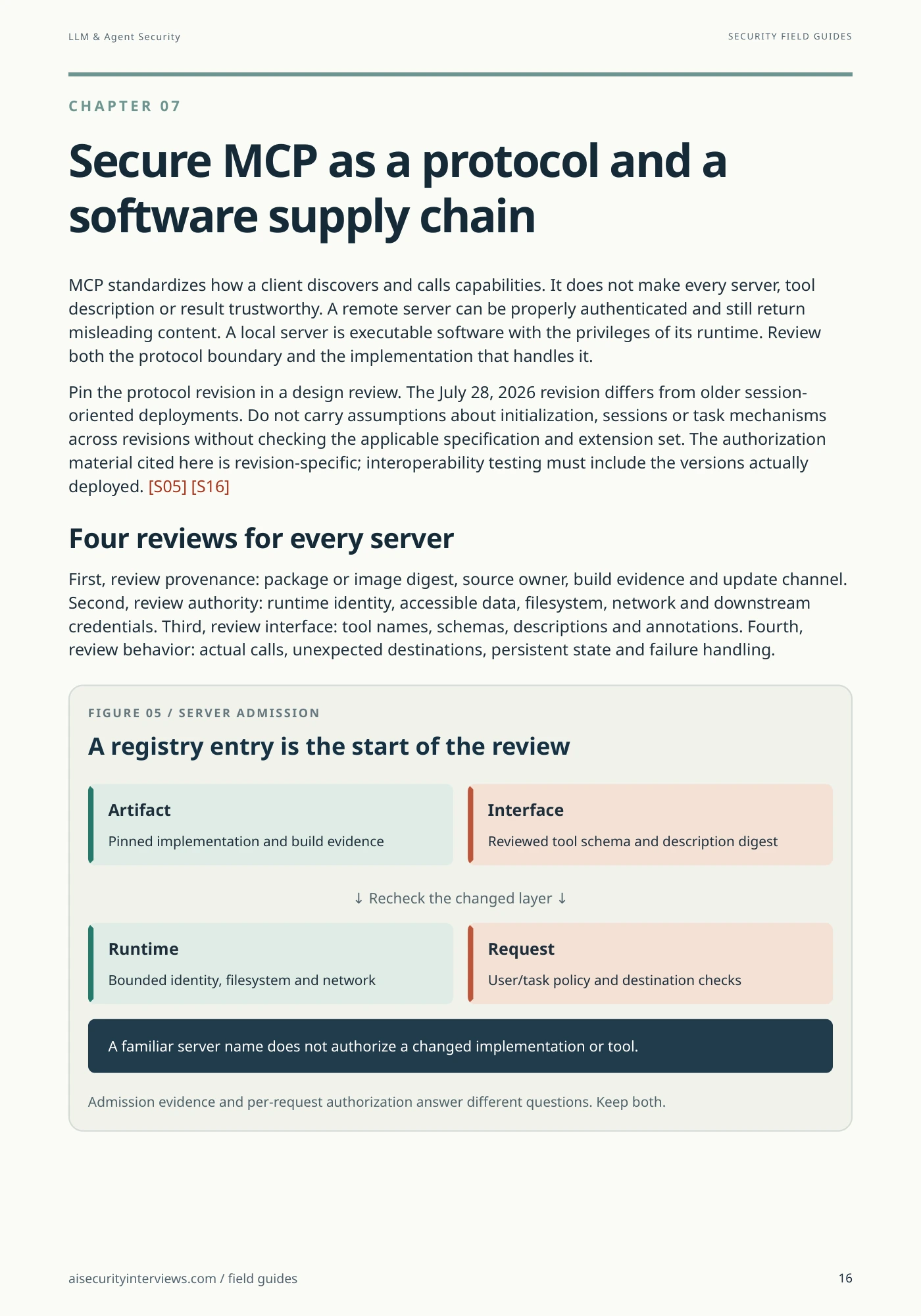
FIGURE 05 / SERVER ADMISSION
A registry entry is the start of the review
Artifact
Pinned implementation and build evidence
Interface
Reviewed tool schema and description digest
↓ Recheck the changed layer ↓
Runtime
Bounded identity, filesystem and network
Request
User/task policy and destination checks
A familiar server name does not authorize a changed implementation or tool.
Admission evidence and per-request authorization answer different questions. Keep both.
LLM & Agent Security
SECURITY FIELD GUIDES
aisecurityinterviews.com / field guides
16
Bind approval to the exact action
Page 32 of 47
Read sample text
C H A P T E R 1 5
Bind approval to the exact action
Human approval is useful only when the person can understand and control the effect being
approved. A friendly summary produced by the same model proposing the action may omit critical
fields. Build the approval view from the normalized operation that the executor will use, and present
the fields that materially change risk: target, destination, content, amount, permissions and affected
resources.
Approval is a grant with scope and expiry. It is not a general statement that the agent may continue
doing whatever seems useful. If the destination or payload changes, compare the new operation
against the approved operation and obtain fresh authorization when the change falls outside the
grant.
Prepare, approve, commit
First prepare a canonical operation and a digest over its meaningful fields. Then show a trusted
preview and record the approving principal, digest, expiry and relevant resource version. Finally, at
commit, check authorization again, recompute the digest, verify the resource version and consume
the grant under the same transactional rules as the effect.
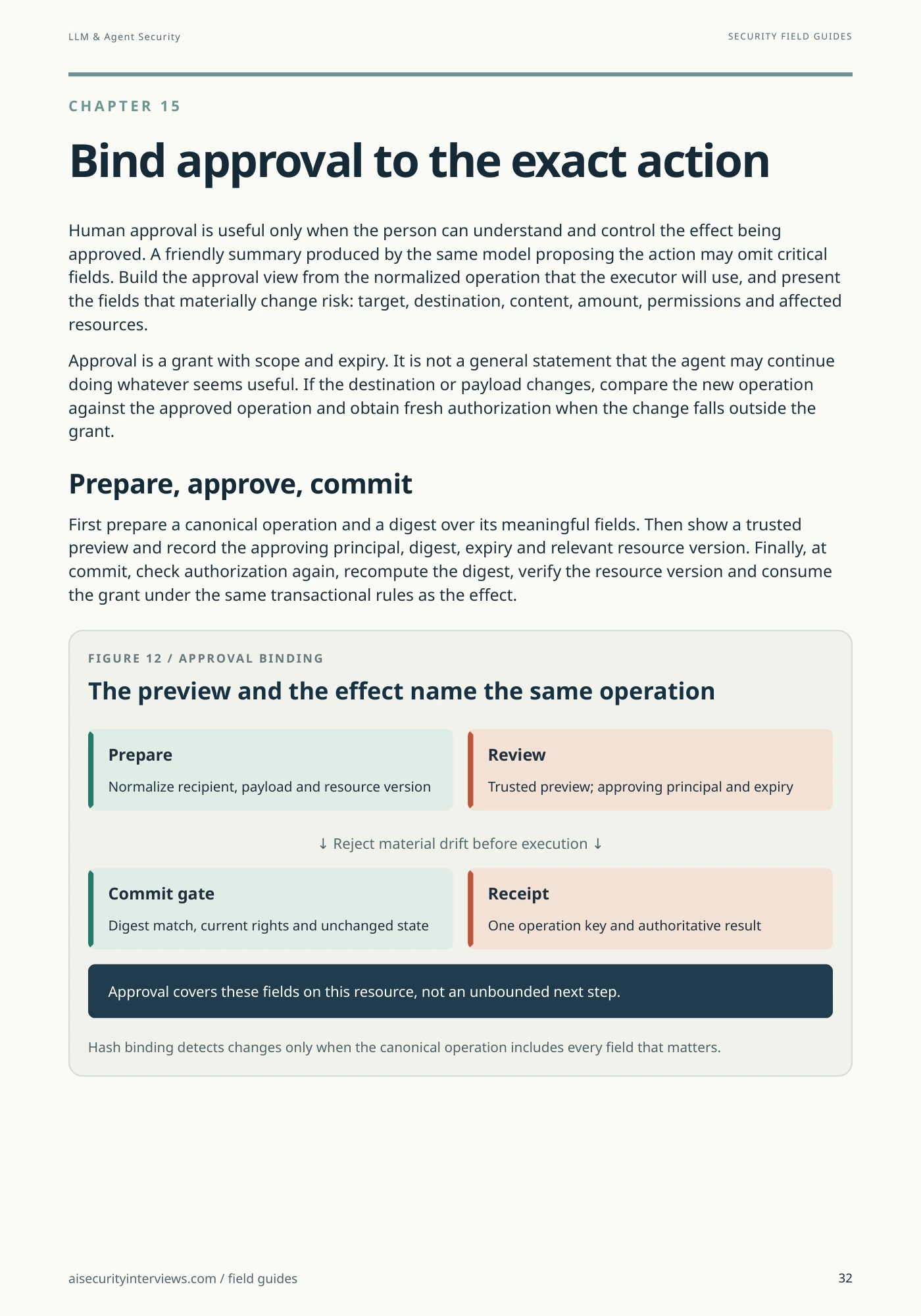
FIGURE 12 / APPROVAL BINDING
The preview and the effect name the same operation
Prepare
Normalize recipient, payload and resource version
Review
Trusted preview; approving principal and expiry
↓ Reject material drift before execution ↓
Commit gate
Digest match, current rights and unchanged state
Receipt
One operation key and authoritative result
Approval covers these fields on this resource, not an unbounded next step.
Hash binding detects changes only when the canonical operation includes every field that matters.
LLM & Agent Security
SECURITY FIELD GUIDES
aisecurityinterviews.com / field guides
32
A 47-page PDF with selectable text, linked contents, 15 diagrams, worked cases and references. The web previews are actual pages from this edition.
Which membership includes this book?
An active paid Premium membership, eligible All-Access Pass or approved full-access grant includes the PDF. Referral study days unlock online learning but exclude downloads. You can keep a file you downloaded while eligible.
How does this fit with the online material?
Use the book for a connected reading sequence. Chapter links lead to concepts, worked questions and courses on this site, where the access tier of each page still applies.
Does it include live attack labs?
The exercises teach defensive reasoning and offline checks with synthetic data. There are no working exploits or injection payloads. Testing guidance is limited to systems you own or are explicitly authorized to assess.
Technical sources reviewed 2026-11-11. Product details can change; the book distinguishes research findings from guarantees for a deployed system.