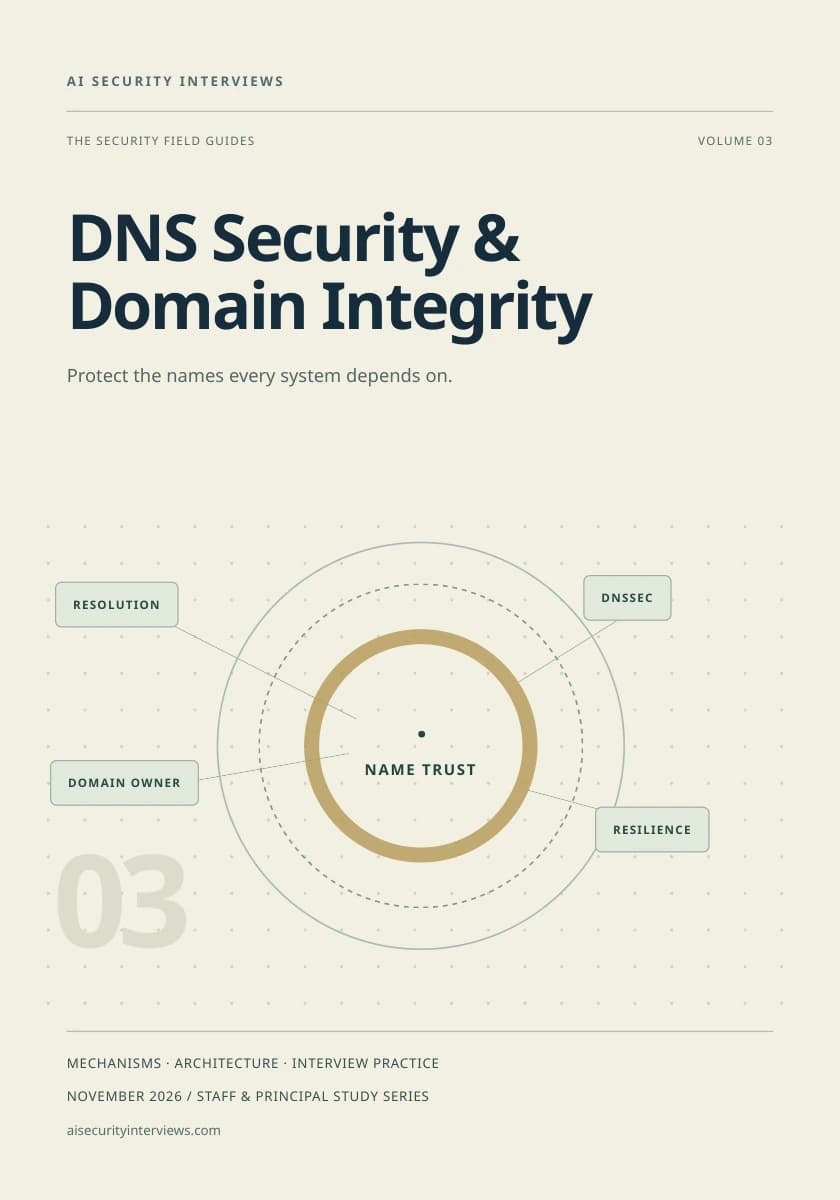
Understand DNS from wire semantics to domain ownership. Build reliable validation, encrypted resolution, protective policy and incident response without confusing authenticity with safety.
Explain what DNSSEC, encrypted DNS and protective DNS each establish, and where their guarantees end.
Plan key rollovers and provider migrations around real cache and propagation dependencies.
Protect domain ownership, certificate issuance and mail policy as connected control planes.
Diagnose resolution failures and suspicious behavior with evidence that distinguishes policy, validation and transport.
Inside the book
01. Follow a name through its trust boundariesp. 4
02. Read response semantics before diagnosing the networkp. 6
03. Model caches as distributed statep. 8
04. Keep large answers working without fragmentationp. 10
05. Validate DNSSEC as a chain of signed datap. 12
06. Prove absence without making validation expensivep. 14
07. Plan key changes from dependencies and cache lifetimesp. 16
08. Operate validators as bounded critical servicesp. 18
09. Protect authoritative publication and provider changesp. 20
10. Choose encrypted DNS with an explicit trust modelp. 22
11. Account for discovery, service bindings and ECHp. 24
12. Publish protective DNS policy like application codep. 26
13. Detect suspicious behavior with context and base ratesp. 28
14. Protect domain ownership through the whole lifecyclep. 30
15. Connect DNS to certificate issuance and renewalp. 32
16. Distinguish mail authentication from transport securityp. 34
17. Engineer availability across routing and failure domainsp. 36
18. Diagnose an outage with competing hypothesesp. 38
19. Put DNS inside the AI-agent egress modelp. 40
20. Rehearse three architecture reviewsp. 42
21. Offline exercises for cache timing and triagep. 44
Read a few pages
Select a page for a larger view. A text version is available beneath each sample.
Keep large answers working without fragmentation
Page 10 of 48
Read sample text
C H A P T E R 0 4
Keep large answers working without
fragmentation
DNS over UDP is efficient, but large responses can exceed a path's usable packet size. EDNS lets a
requester advertise capacity; that advertisement does not guarantee that every network path can
carry a datagram of that size. Fragment loss, filtering and implementation differences can turn large
signed responses into intermittent failures.
RFC 9715 describes fragmentation avoidance, including response sizing and transport fallback. [S10]
The often-used 1232-byte UDP payload budget derives from the IPv6 minimum MTU of 1280 bytes
minus a 40-byte IPv6 header and an 8-byte UDP header, before additional encapsulation. It is a useful
conservative reference, not proof that every tunneled path has the same usable budget.
Truncation must lead somewhere
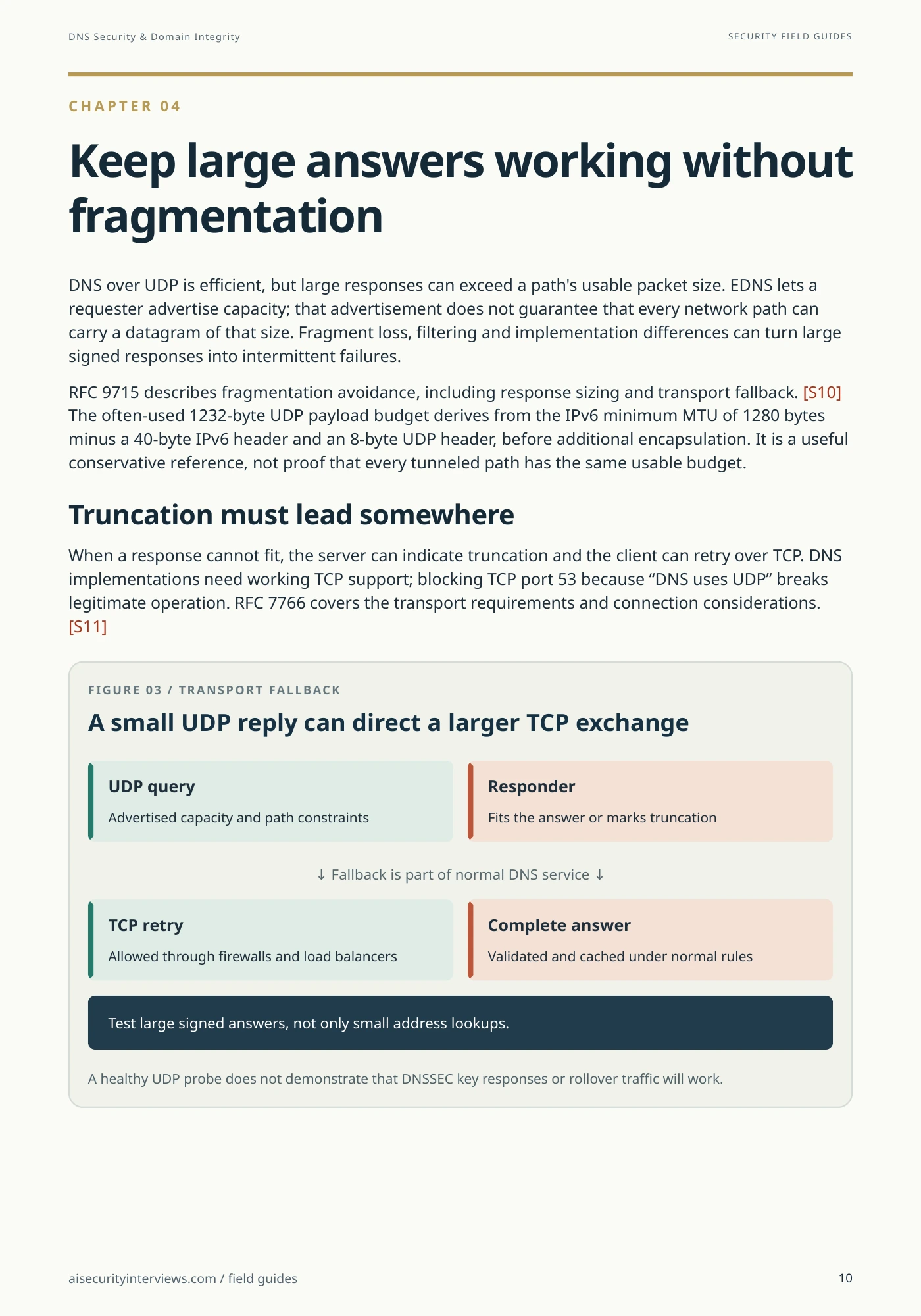
When a response cannot fit, the server can indicate truncation and the client can retry over TCP. DNS
implementations need working TCP support; blocking TCP port 53 because “DNS uses UDP” breaks
legitimate operation. RFC 7766 covers the transport requirements and connection considerations.
[S11]
FIGURE 03 / TRANSPORT FALLBACK
A small UDP reply can direct a larger TCP exchange
UDP query
Advertised capacity and path constraints
Responder
Fits the answer or marks truncation
↓ Fallback is part of normal DNS service ↓
TCP retry
Allowed through firewalls and load balancers
Complete answer
Validated and cached under normal rules
Test large signed answers, not only small address lookups.
A healthy UDP probe does not demonstrate that DNSSEC key responses or rollover traffic will work.
DNS Security & Domain Integrity
SECURITY FIELD GUIDES
aisecurityinterviews.com / field guides
10
Plan key changes from dependencies and cache lifetimes
Page 16 of 48
Read sample text
C H A P T E R 0 7
Plan key changes from
dependencies and cache lifetimes
A key rollover is a sequence of publications that must remain valid for clients holding different cache
states. The objective is to avoid a period in which an old cached key cannot validate a new signature,
or a cached parent DS refers only to a key the child no longer serves. RFC 7583 describes the timing
dependencies that make this more than a local key replacement. [S08]
Separate key generation, publication, activation, retirement and removal. A key can be published
before it signs data. A retired key may need to remain available while cached signatures or parent
information still refer to it. An implementation's automation should expose these states and their
evidence rather than hiding them behind a single “rotate” button.
Build the overlap deliberately
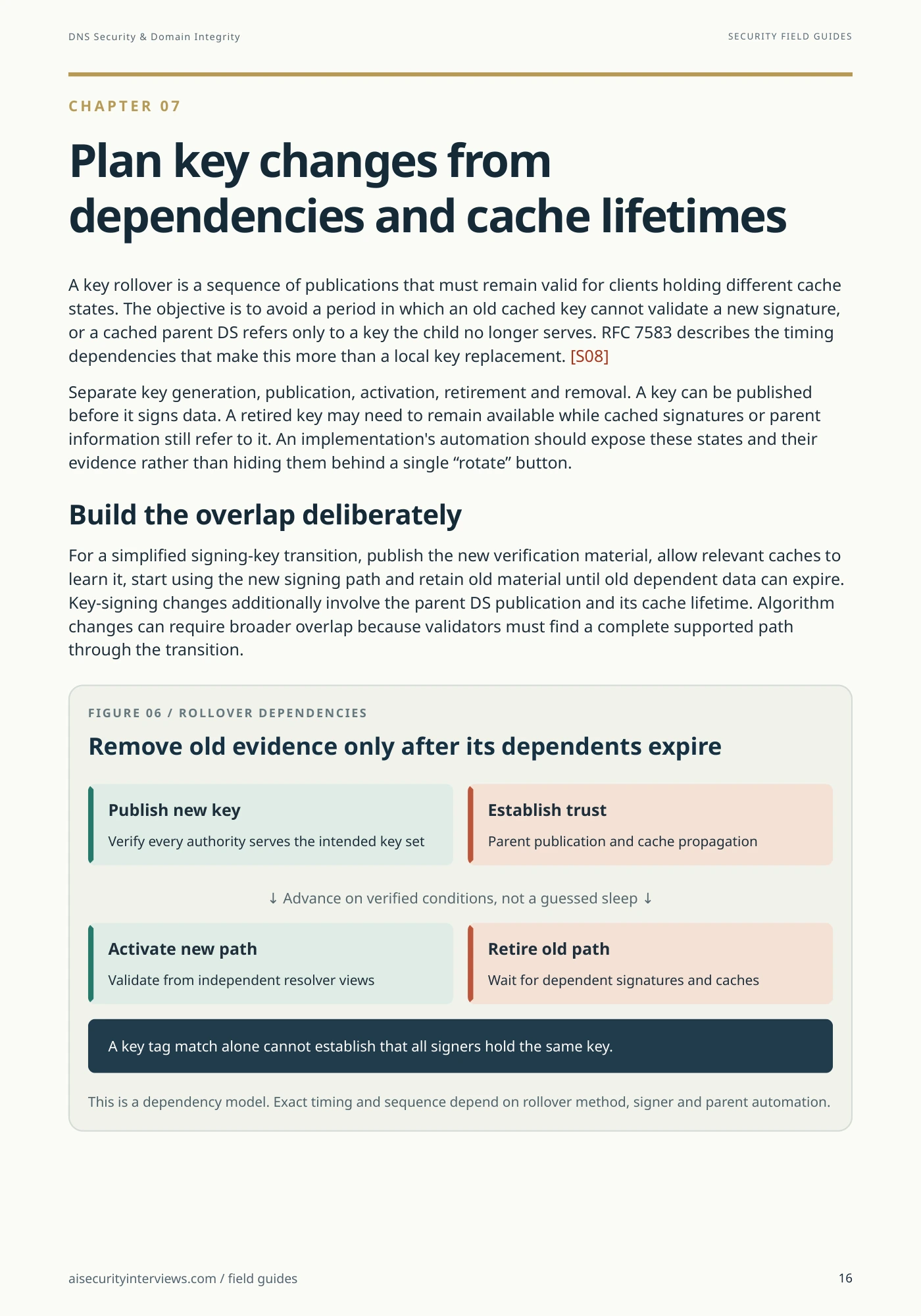
For a simplified signing-key transition, publish the new verification material, allow relevant caches to
learn it, start using the new signing path and retain old material until old dependent data can expire.
Key-signing changes additionally involve the parent DS publication and its cache lifetime. Algorithm
changes can require broader overlap because validators must find a complete supported path
through the transition.
FIGURE 06 / ROLLOVER DEPENDENCIES
Remove old evidence only after its dependents expire
Publish new key
Verify every authority serves the intended key set
Establish trust
Parent publication and cache propagation
↓ Advance on verified conditions, not a guessed sleep ↓
Activate new path
Validate from independent resolver views
Retire old path
Wait for dependent signatures and caches
A key tag match alone cannot establish that all signers hold the same key.
This is a dependency model. Exact timing and sequence depend on rollover method, signer and parent automation.
DNS Security & Domain Integrity
SECURITY FIELD GUIDES
aisecurityinterviews.com / field guides
16
Publish protective DNS policy like application code
Page 26 of 48
Read sample text
C H A P T E R 1 2
Publish protective DNS policy like
application code
Protective DNS applies a local decision to a name-resolution request or response. It can block known
harmful destinations, enforce an approved namespace policy or route selected queries to controlled
handling. Its effectiveness depends on clients using the service and on the policy's coverage. It
cannot prove that an allowed destination is benign or stop every connection made without a DNS
lookup.
Treat policy feeds as untrusted inputs to a controlled publication pipeline. Normalize records, validate
scope, attach evidence and expiry, detect conflicts and test candidate changes before broad rollout. A
mistaken block on an identity provider or package service can interrupt many applications at once.
Separate evidence from enforcement
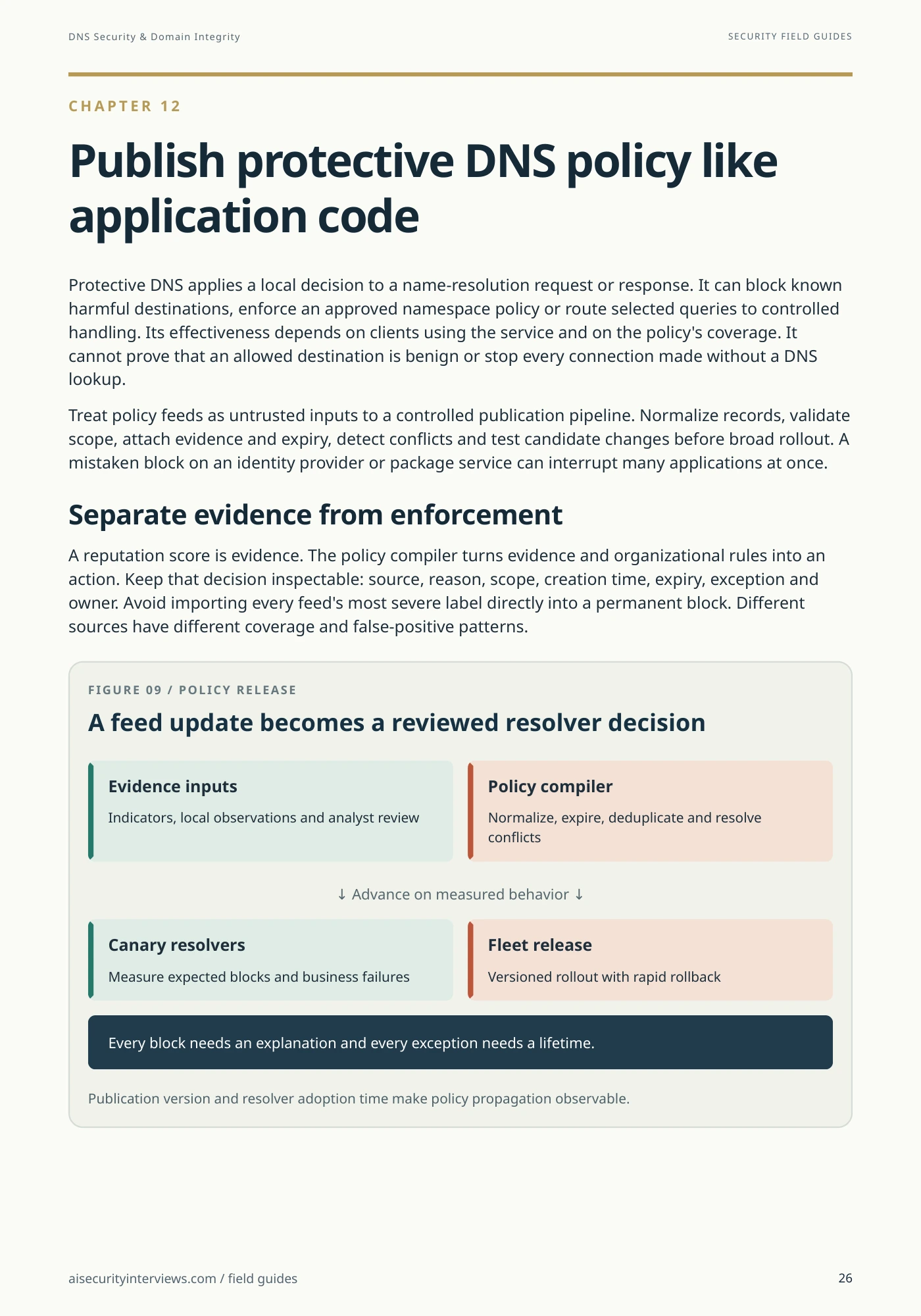
A reputation score is evidence. The policy compiler turns evidence and organizational rules into an
action. Keep that decision inspectable: source, reason, scope, creation time, expiry, exception and
owner. Avoid importing every feed's most severe label directly into a permanent block. Different
sources have different coverage and false-positive patterns.
FIGURE 09 / POLICY RELEASE
A feed update becomes a reviewed resolver decision
Evidence inputs
Indicators, local observations and analyst review
Policy compiler
Normalize, expire, deduplicate and resolve
conflicts
↓ Advance on measured behavior ↓
Canary resolvers
Measure expected blocks and business failures
Fleet release
Versioned rollout with rapid rollback
Every block needs an explanation and every exception needs a lifetime.
Publication version and resolver adoption time make policy propagation observable.
DNS Security & Domain Integrity
SECURITY FIELD GUIDES
aisecurityinterviews.com / field guides
26
A 48-page PDF with selectable text, linked contents, 15 diagrams, worked cases and references. The web previews are actual pages from this edition.
Which membership includes this book?
An active paid Premium membership, eligible All-Access Pass or approved full-access grant includes the PDF. Referral study days unlock online learning but exclude downloads. You can keep a file you downloaded while eligible.
How does this fit with the online material?
Use the book for a connected reading sequence. Chapter links lead to concepts, worked questions and courses on this site, where the access tier of each page still applies.
Does it include live attack labs?
The exercises teach defensive reasoning and offline checks with synthetic data. There are no working exploits or injection payloads. Testing guidance is limited to systems you own or are explicitly authorized to assess.
Technical sources reviewed 2026-11-11. Product details can change; the book distinguishes research findings from guarantees for a deployed system.